

Short answer: you can build most of your HYROX fitness in an ordinary commercial gym. Running is running, and smart substitutions cover the engine and strength-endurance work behind every station. What a regular gym can't give you is the race-specific skill layer — the sled on carpet, the wall ball standard, the rhythm of running on legs a station just emptied. Train the engine anywhere; rehearse the race somewhere that has the stations. Here's exactly how to split that work.
First, the honest framing. A substitution is useful when it matches the stimulus of a station — the muscles, the duration, the heart-rate cost. It becomes a problem when you convince yourself it matches the skill. Leg pressing heavy doesn't teach you the body angle that keeps a 152 kg sled moving, and dumbbell thrusters don't teach you what rep 70 of 100 wall balls feels like with a judge counting depth. Use substitutions to build capacity. Don't let them convince you you've rehearsed the race.
SkiErg: 1,000 m of upper-body pulling
The SkiErg is a hinge-and-pull pattern — lats, triceps and core driving the handles down while the hips snap. If your gym has a rower but no SkiErg, the rower covers the engine cost (similar duration, similar heart-rate zone) but reverses the emphasis from pulling down to driving with the legs, so add direct pulling work. If it has neither, build the pattern with cable or band work.
- Closest sub: straight-arm cable pulldowns or heavy band pull-downs done for timed sets (45–90 seconds), paired with hard hinge work
- Engine sub: 1,000 m row intervals at the same effort you'd target on the Ski — controlled, about 85% of fresh pace
- Pattern builder: kneeling med-ball slams for rhythm and hip drive — moderate ball, high reps
- What doesn't transfer: light lat pulldowns for sets of 10. The station is 3.5–4.5 minutes of continuous work — train time domains, not rep counts
Sled push and sled pull: the honest problem
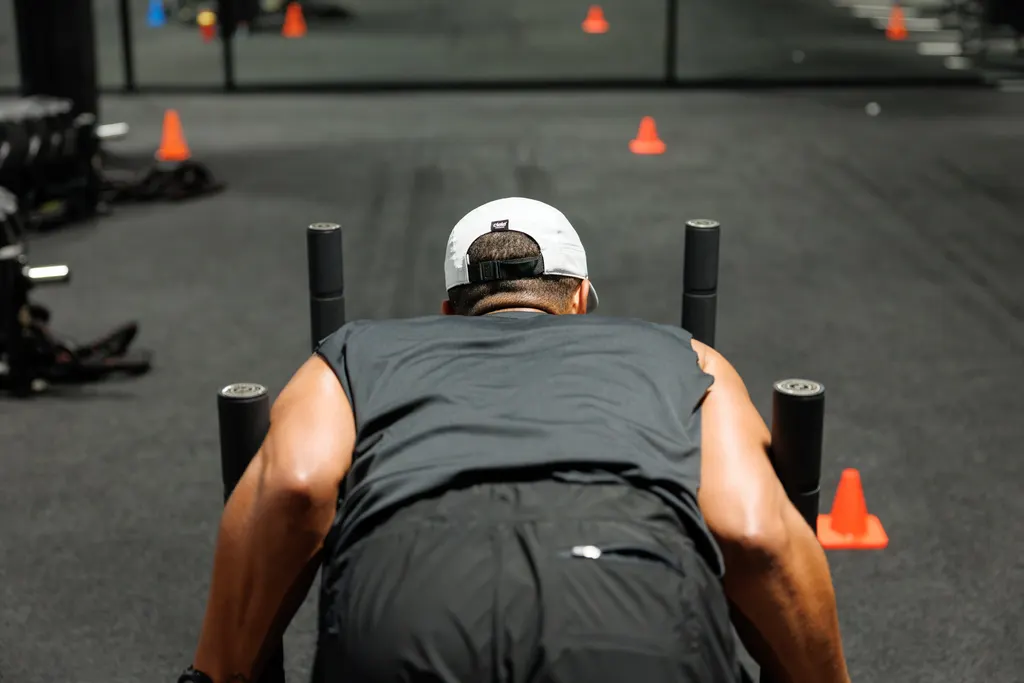
This is where false equivalence hurts people. Race sleds run on carpet at loads of 102–152 kg total for the push in the open division (more for pro), and the friction makes them feel heavier than almost any gym sled. If your gym has no sled at all, you can train the qualities underneath the station — leg drive, posterior chain, grip — but you should know that none of these subs teach the position, and position is what the sled actually tests.
- Leg drive: heavy walking lunges and step-ups, plus leg press done in longer sets of 15–25 reps
- Push pattern: treadmill pushes — treadmill off, hands on the rail, drive the belt with short choppy steps in 30–45 second efforts
- Pull pattern: heavy seated cable rows and backward drags with a plate on a towel if your gym's floor allows it
- Hills: short, steep hill sprints are the best sled-push stand-in nature offers
- The gap that remains: body angle, arm lockout and the specific heart-rate spike of race-load sleds — rehearse these on real equipment before race day
Row: the easy one
Most gyms have a rower, so most athletes don't need a substitute — they need to practice rowing at race effort, which is deliberately conservative: roughly your 2K pace plus 10–15 seconds per 500 m, legs doing the work at a stroke rate of 24–28. If your gym somehow lacks a rower, an air bike at matched duration covers the aerobic cost, though it spares your grip and lats the fatigue the race will not.
Farmers carry: substitutable almost anywhere
The race asks for 200 m with kettlebells — 2 × 16 kg for open women, 2 × 24 kg for open men. Any gym with dumbbells or kettlebells can train this honestly. The details that matter: carry at or above race load, walk fast with tall posture, and build grip endurance separately, because in the race this station arrives after a sled pull has already taxed your forearms.
- Main work: carries at race weight or heavier for 50–100 m segments, minimal rest
- Grip capacity: dead hangs from a pull-up bar, building toward 60+ seconds
- Space problem? Walk laps of whatever floor you have — turns cost a little rhythm, not the adaptation
Sandbag lunges: mind the loading position
One hundred meters of walking lunges with a bag on your shoulders (10 kg open women, 20 kg open men). Dumbbells at your sides are the common gym substitute, and they're better than nothing — but they load your grip instead of your trunk and let you escape the upright posture the bag enforces. A barbell in a back-rack position is closer. A loaded backpack or any bag you can drape across your shoulders is closer still.
Standards matter here too: back knee touches down, hips and knees fully extend at the top. Practice the full standard every rep, because a judge will hold you to it at the end of a very long day.
Wall balls: the ceiling problem
The final station is 100 wall balls to a 2.70 or 3.00 m target. If your gym has no target — or no ceiling height — the working substitute is a dumbbell or med-ball thruster: full-depth squat into a drive overhead, done in the big sets the race demands. What the thruster can't give you is the catch — absorbing the ball into your next squat — or the target accuracy that earns no-reps when it fades. If there's any wall and any med ball available, even throwing to a mark on the wall beats a thruster for transfer.
- Sub: thrusters in planned break schemes — 5×20 or 10×10, rehearsed exactly as you'll break them in the race
- Do them tired: wall balls are last for a reason — put your sets at the end of hard sessions
- Train the legs they'll arrive on: pair squats or lunges immediately before your throwing sets
What you genuinely can't fake
Three things resist every substitution. First, compromised running — the specific misery of running a kilometer on legs the sled just emptied. You can approximate it (hard station work straight into intervals), but the full eight-round rhythm only shows up when you run the actual sequence. Second, the sled itself, covered above. Third, pacing: knowing what 85% feels like at station 2 versus station 7 is learned in full simulations, not in pieces.
This is the honest case for training at least part of your block somewhere with all eight stations. At DPS — an Official HYROX Training Club here in Dallas — the floor runs race-spec sleds on turf lanes, SkiErgs, rowers, competition kettlebells, sandbags and wall ball targets, and our 12-week Race Prep Block builds two full simulations into the calendar. Plenty of our athletes do their running and strength work elsewhere all week and come in for coached station work and classes. That split works. Guessing at the sled until race day does not.
Rehearse the stations you can't substitute
Your first HYROX-style class at DPS is part of the free trial — all 8 stations, race-spec equipment, no card required.
Frequently asked questions
Can I get ready for HYROX at a regular commercial gym?
Mostly, yes. Running volume, strength endurance, carries, lunges and rowing cover the majority of race fitness and work in any gym. The gaps are the sled stations, wall ball standards and full race simulations — plan to rehearse those on real equipment at least a few times before race day.
What's the best substitute for the sled push?
There isn't a true one — that's the honest answer. Heavy walking lunges, longer leg-press sets, treadmill pushes with the belt off and steep hill sprints build the qualities underneath the station, but none of them teach race-sled body position or the friction of carpet. Treat subs as capacity work and schedule real sled sessions before you race.
How many sessions on real HYROX equipment do I actually need?
Fewer than you'd think if your general training is consistent. Athletes who train everything else elsewhere typically do well rehearsing stations once a week in the final 8–12 weeks, plus at least one full simulation. The simulation matters most — pacing eight rounds is a skill of its own.
Are dumbbell lunges good enough for the sandbag station?
They're a usable base, but they load your grip instead of your trunk and don't enforce the upright posture a shoulder-loaded bag does. A barbell back-rack carry-lunge, or any bag draped across your shoulders, transfers better. Whatever you use, hit the full standard — back knee down, full extension up top.
Does DPS offer a way to train the stations without a membership?
Yes — the free trial is a 3-day pass that includes HYROX-style classes on the full station floor, a facility tour and no card requirement. After that, class memberships cover coached HYROX training, and the 12-week Race Prep Block adds pacing work and two full race simulations.
Put it together
Train your runs and your strength anywhere — consistency beats equipment for that 80%. Then be ruthless about the remaining 20%: real sleds, real wall balls, real simulations, rehearsed enough times that race day contains no surprises. If you're racing HYROX Dallas this November, the window to do both is now.
All 8 stations. One floor. Coached.
HYROX-style classes and a 12-week race prep block at Dallas's Official HYROX Training Club — first class free.